“History’s all lies”
Operation Napoleon“History’s all lies” is Vytautas Carr’s blunt expression for a world in which official accounts are made, unmade, and rewritten by the people tasked with managing secrets. Its force lies not in proving that every account is false, but in showing how truth becomes entangled with omission, substitution, rumor, and restricted knowledge around Operation Napoleon.
The exchange that defines the phrase
Carr’s formulation answers Colonel Miller’s distinction between making history and leaving that task to others. Miller says, “It’s not our job to write history; that’s for others to do,” and Carr counters, “No, our job has always been to wipe the slate clean and rewrite it.” The exchange turns a general reflection into an admission about their work: intervention in the historical record is not an accidental consequence but part of the job.
Carr elaborates through a sequence of reversals: “we’ve told the truth about lies and lied about the truth, taken out one thing and substituted another.” The phrasing makes truth and falsehood difficult to separate from the acts of selection and replacement. He recalls Miller’s description of human history as “a register of crimes and misfortunes,” then adds that it is also “a register of carefully constructed lies.” The added qualification matters: the lies are constructed, not merely random errors, and their apparent order can conceal the process that produced them.
Rumor, testimony, and the missing plane
The novel gives that claim a concrete setting in the long secrecy surrounding the plane on Vatnajökull. A former serviceman recalls that rumors circulated about what the military was seeking; some suspected a plane carrying dangerous cargo. Under Leo Stiller’s direction, regular flights photographed the glacier’s southeastern section once a month, but the witness says he never saw anything himself. Reports of possible sightings prompted closer inspections, leaving a trail of suspicion without a witness who could confirm what had been found.
Sarah Steinkamp supplies a more definite but still attributed account: she says Leo knew about the plane and told her it belonged to the Nazis. His death follows that disclosure in her telling, but the exchange establishes what Sarah says Leo told her, not an independent confirmation of the aircraft’s history. The distinction between a reported statement and a verified fact is central to the expression’s reach: information travels through people, and each account has its own limits.
Secrecy and the transmission of knowledge
Jón’s silence offers another form of historical shaping. He has kept a promise made with his brother to Colonel Miller and has told no one what he knew, even after his brother’s death. When Kristín confronts him over the American soldiers’ role in her brother’s likely death, Jón reveals that the expedition leader is called Ratoff. His disclosure is partial: a name emerges, while the older promise and the knowledge it protected remain part of the history of concealment.
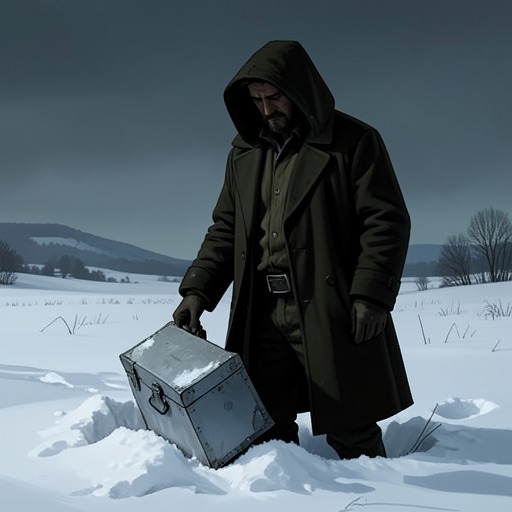
A damaged metal case gives the secret a physical trace. Jón passes Kristín a small, battered box containing papers ruined by years of changing weather. The typewritten German documents are mostly blurred or illegible, but one fragment still bears the words “Operation Napoleon.” The papers appear to connect the operation to an actual documentary record, yet their damaged condition prevents them from serving as a complete explanation. The object is evidence and an obstacle at once: it preserves a name while withholding the contents that might explain it.
The limits of an insider’s account
Colonel Miller later stresses that only a tightly controlled number of people in the army knew about Operation Napoleon. He says he never knew exactly what it entailed or what its documents contained; what he knew came by hearsay, and he describes himself and his brother as pawns assigned to solve a specific problem. He believes that a small group of American generals in Europe conceived the operation and that talks were held with the Germans as the war’s outcome became clear, but he does not claim direct knowledge of who initiated the idea or what the documents said.
That admission complicates Carr’s sweeping phrase. Even a man involved in the operation cannot supply a complete account of it. The novel places Miller’s qualified recollection beside Jón’s long silence, Sarah’s report of Leo’s words, the serviceman’s account of surveillance flights, and the fragmentary German papers. These sources do not collapse into one fully verified narrative. Together, they show why rewriting history can mean more than inventing a false story: it can also mean controlling access, preserving only fragments, and leaving those who come later to distinguish what was witnessed from what was heard, remembered, or hidden.